You find a sponsor by first showing what a brand gets from working with you, and only then applying. The order is: clarify your profile, understand the brand’s audience, select suitable brands, write a personal message and follow up. Start with a hundred identical emails and you will receive a hundred rejections — or no reply at all.
This article outlines six steps for triathletes, runners, trail runners, cyclists and gravel riders. It draws on conversations with decision-makers at leading endurance sports brands and on what we see every day at athleteXhub.
What brands assess in athletes today
For our State of Endurance Sponsorship 2026 report, we interviewed decision-makers at leading brands during Challenge Roth. The most important insight for you: reach rarely decides everything on its own.
| What brands assess first | Share of brands interviewed |
|---|---|
| Personality and values | 40% |
| Athletic performance | 27% |
| Social media reach | 13% |
| Content quality | 7% |
At the same time, 93% of brands measure reach internally. That is not a contradiction: reach is a number that is easy to explain within a company. Selection, however, often depends on personality, values and reliability. For you, this means an account with 3,000 followers and a clear identity can be more interesting than one with 30,000 followers and no direction.
There is another challenge on the brand’s side: 40% of the brands interviewed receive 50 or more enquiries per month. Your message competes with many others that are not a good fit. That is why well-prepared enquiries stand out.
Step 1: Clarify what you offer a brand
Sponsorship is an exchange, rather than a gift. Brands expect visibility among an audience they find difficult to reach themselves, credibility and reliability over time. Start by writing down three sentences:
- Who are you? Your sport, level and goal for the next twelve months.
- Who do you reach? What kinds of people follow you, and why?
- What specifically do you offer? For example, product reviews, race reports, videos, event appearances or a discount code for your community.
If you cannot explain this in three sentences, you are not ready to send your enquiry yet. That is not a flaw; it is your task for the coming weeks.
Step 2: Make your profile understandable in 60 seconds
During the first minute, a brand usually looks at five things:
- Profile picture and bio: Is it immediately clear who you are and what you stand for?
- Your last nine posts: Is there a recognisable direction?
- Engagement: Do people actively respond? For many brands, an account with 2,000 followers and 8% engagement is more interesting than one with 20,000 followers and 0.5%.
- Comment quality: Genuine questions and reactions, or just emojis?
- Story activity: Do you post regularly, rather than only before races?
If one of these is weak, the brand moves on to the next enquiry. Fix the weakest area first.
Step 3: Know five key figures by heart
You do not need a 20-page media kit. You need five figures you can share at any time:
- Average reach per post over the last 30 days
- Engagement rate
- Average story views
- Profile visits per month
- Percentage growth over the last 90 days
Knowing these figures makes you come across as a partner, rather than someone simply hoping for support.
Step 4: Choose brands that fit you, rather than the biggest names
Most athletes first contact the brands they recognise from race numbers and livestreams. Those brands also receive the most enquiries. A better approach: look for brands whose products you already use, whose values match yours and that already work with athletes at your level.
Useful questions before every enquiry:
- Which athletes does the brand already work with? Does your profile fit?
- Is there an ambassador programme or an application process?
- What problem can you solve for the brand: a new audience, region, sport or content?
Step 5: Get on the brand’s radar before you write
Two routes lead to sponsorship, and well-prepared athletes use both:
Pull: You become visible in your niche until brands approach you. You are recognisable as the trail runner who focuses on nutrition, or the triathlete who openly shares their training plan. When you show products you genuinely use on your own initiative, without a paid partnership behind it, brands remember.
Push: You actively approach a brand. Beforehand, publish three to five pieces of content related to its area — because the subject interests you, rather than as hidden advertising. Then write a personal message. Our article on your sponsorship pitch deck as an athlete explains how to present your offer to brands.
Step 6: Follow up with added value
It is normal for a brand not to reply immediately. Wait one to two weeks, then get back in touch with something new: a race result, a post that performed well or a specific proposal. “Have you seen my email?” adds no value.
The most common mistakes
- Sending the same email to every brand. Brands recognise this immediately.
- Starting with a request. “I am looking for a sponsor” tells the brand nothing about what it gets in return.
- Focusing only on followers. As shown above, personality and values come first for the brands interviewed.
- Unrealistic expectations. Most collaborations start with products, rather than money.
How athleteXhub helps
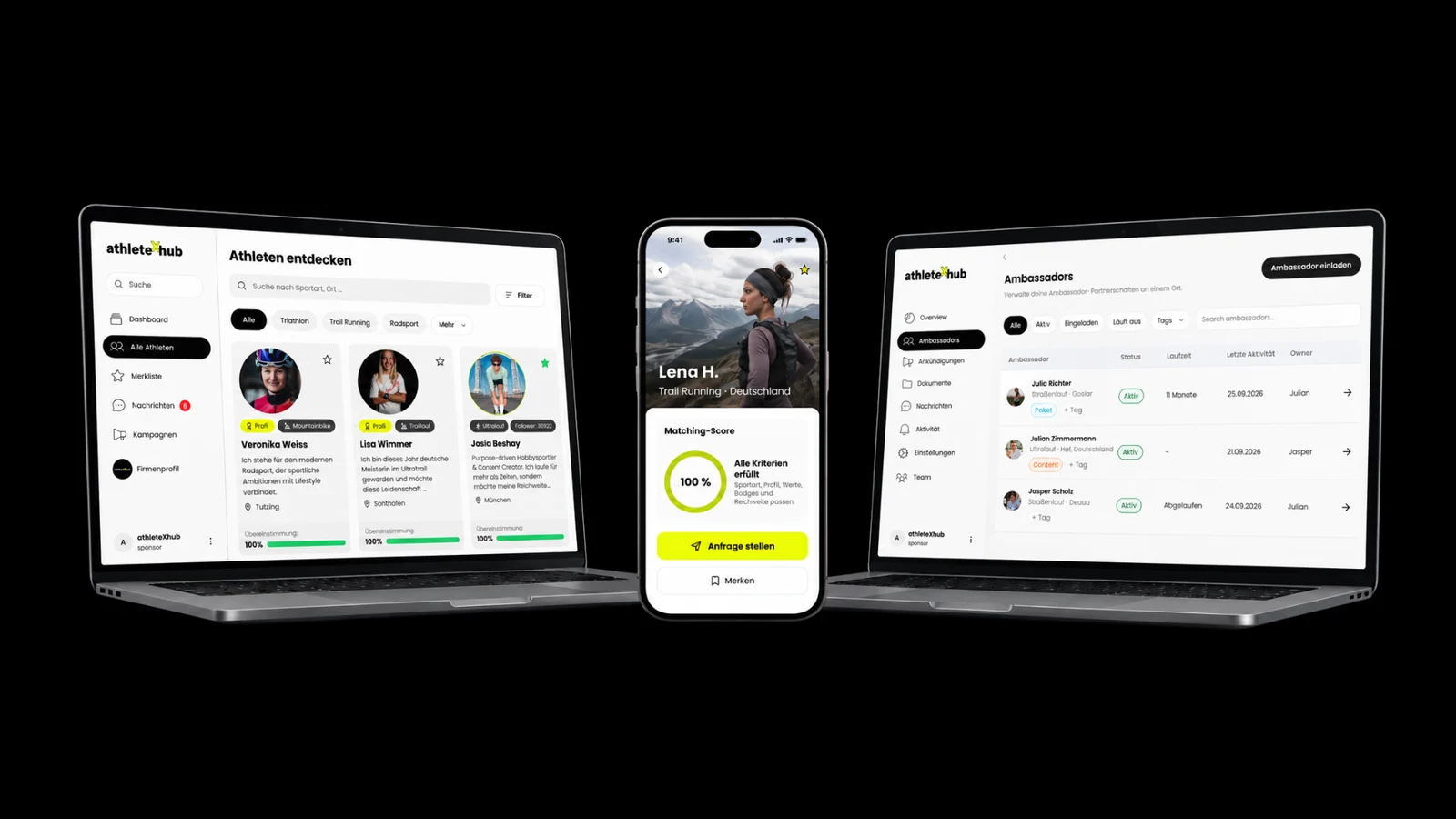
athleteXhub is an endurance sports sponsorship platform for Germany, Austria and Switzerland. You build a profile that brands can understand in a minute and see your Matching Score for each brand. At a 100% match, you can contact the brand directly; at a lower score, you can see what is missing. This helps you understand whether an enquiry is worthwhile before sending it. An online academy offers courses on personal branding, social media and sponsor readiness. More than 300 athletes are currently registered.
We do not promise you a sponsor. We help you prepare so that you do not send enquiries blindly.
Register for free and see your Matching Score
FAQ: Finding a sponsor as an athlete
How many followers do I need to get a sponsor?
There is no fixed threshold. According to State of Endurance Sponsorship 2026, only 13% of the brands interviewed assess reach first, while 40% assess personality and values first. Many programmes still set a minimum audience size; on athleteXhub, each brand defines its own requirements.
When should I start looking for sponsors?
Once you have a clear profile, five key figures and a specific offer. Preparation usually takes longer than writing the enquiry itself.
Do athletes receive only money, or products too?
Product sponsorship is the most common form: 93% of the brands interviewed use it, alongside 87% offering paid partnerships.
What does it cost to look for a sponsor on athleteXhub?
Registration is free. The premium subscription, which includes direct contact with brands and applications for deals, costs €14.99 per month, including 19% VAT.