Finding sponsors as an athlete: The 9 most important tips for long-term partnerships
Whoever practises sports ambitiously, sooner or later reaches the same point: Training becomes more intense, competitions become bigger and with them, the costs rise. Start fees, travel, equipment or training camps add up quickly. At the same time, the desire for a company to support one's own way grows. Exactly then, many athletes ask themselves the same question: How can I find sponsors as an athlete?
The good news is: Sponsoring is not a coincidence. And it is not a privilege for professionals or influencers with hundreds of thousands of followers.
In recent years, sports sponsorship has changed significantly. Today, companies are no longer looking exclusively for the most successful athletes. They are looking for personalities. People with a story, a clear attitude and an authentic connection to their community. This is exactly where the opportunity lies for ambitious amateur and semi-professional athletes.
Of course, sporting successes help. But they are rarely the only reason for a collaboration. Much more important is the question of what added value you can offer a company and how professionally you present yourself.
If you want to find sponsors as an athlete for the first time, you will quickly notice that it is not just about sporting performances. Much more important are your appearance, your story and the added value you can offer companies. In this article, we will show you the most important steps to significantly increase your chances of long-term sponsorship partnerships.
Here you will learn…
- why good performances alone are often not enough
- what companies really expect from athletes today
- how you find suitable sponsors
- how you contact companies professionally
- which mistakes many athletes make and how you can avoid them
Table of contents
Click on the respective chapter to go directly thereTip 1: Think like a sponsorTip 2: People follow people
Tip 3: The first impression decides
Tip 4: Not every sponsor is the right one
Tip 5: Relationships beat reach
Tip 6: Every request is manual work
Tip 7: Don't sell sports - create added value
Tip 8: Think long-term
Tip 9: Use the right tools
Tip 1
Think like a sponsor
When athletes look for sponsors, they usually ask themselves one question: Which company could support me?
However, another question is much more important: Why should a company work with me?
This is where successful sponsoring begins.
Many associate sponsoring with free products, financial support, or a logo on the competition shirt. In fact, sponsoring is a partnership. Both sides invest something and both sides want to benefit from it.
A company invests money, products, or time. In return, it expects visibility, credibility, authentic content, or access to a specific target group.
Therefore, always put yourself in the perspective of the brand:
What goals does the company pursue?
What values does it want to convey?
What kind of people does it want to reach?
And what contribution can you make to this?
The earlier you understand sponsoring as a cooperation on an equal footing, the more professional you will appear. This change of perspective is what distinguishes many successful athletes from those who keep getting rejections.
Tip 2
People follow people
Athletic achievements impress. Personalities stay in memory.
Imagine two athletes. Both run a marathon in the same time. Both train similarly much. Both post regularly on Instagram.
The first one only publishes target times and medals.
The second one takes his community with him. He shows training sessions, setbacks, nervousness before competitions, and the joy when hard work pays off.
Which athlete can a company probably identify with better?
The answer is obvious.
People are interested in stories. Companies are too.
That's why it's worth thinking about your own positioning: What do you want to stand for?
Maybe you inspire professionals to do ambitious sports despite having little time. Maybe you motivate others to come back after an injury. Or you show how sustainability and endurance sports go together.
It's not about building an artificial brand. It's about making visible who you are anyway.
A strong athlete brand doesn't emerge over a weekend. It develops with every training session, every competition, and every experience you share with others.
Tip 3
The first impression decides
You've found an exciting company and want to make initial contact.
What happens next?
In most cases, someone from the company will form an impression of you within a few minutes. Probably, the person will first land on your Instagram profile, your website, or your athlete profile.
That's why it's worth regularly reviewing your own external appearance from a sponsor's perspective:
Can you quickly find out who you are?
Is it recognisable which sport you practice and what goals you pursue?
Do your contents seem current and authentic?
Many athletes believe they need as many followers as possible. In fact, this is often secondary. Much more important is that your appearance seems professional, honest, and traceable.
Don't just show competition results. Give insights into your training daily life, tell about challenges, take your community with you on the way to your next goal.
This authenticity is what makes you interesting for companies later on.
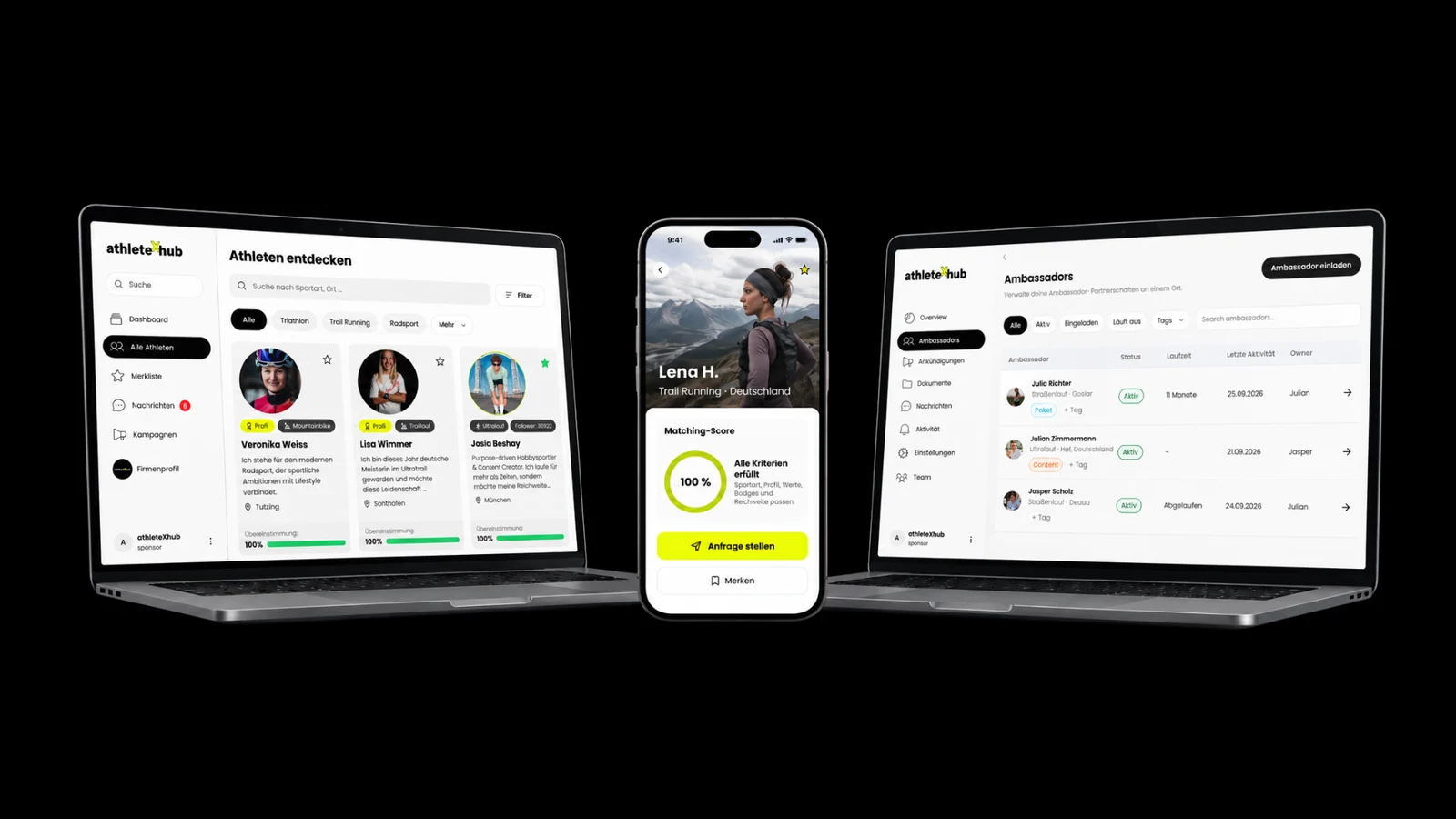
A complete athlete profile athleteXhub profile belongs to this as well. It helps companies understand who you are and why a collaboration might make sense within a few minutes.
Tip 4
Not every sponsor is the right one
A common mistake is to write to as many companies as possible at the same time.
In sponsoring, it's not about finding just any sponsor. It's about finding the right partner.
Many athletes first think of large sports brands. Of course, a collaboration with well-known companies would be exciting. At the same time, these brands receive countless requests every day.
Often, the better chances lie elsewhere.
Regional companies like to support people from their surroundings. Medium-sized businesses are often looking for authentic brand ambassadors and can make decisions much faster than international corporations.
Companies outside the classic sports industry can also fit perfectly with you.
Perhaps you work in a craft business, a tax office or a technology company.
Perhaps you have been using the same nutrition brand for years or always buy your running shoes from the same specialist shop.
Authentic partnerships arise where both sides really fit together.
So do not just ask yourself: Who could support me?
Rather ask yourself: Which brand would I like to work with even without sponsorship?
That's where the best collaborations often begin.
Tip 5
Relationships beat reach
Many first sponsorship partnerships are not created via a perfect email.
They are created through people.
Maybe you talk to an exhibitor after a competition. Maybe your coach knows someone in a company. Maybe a club colleague tells you about an interesting brand or you accidentally meet the marketing person in charge at a trade fair.
Such encounters seem insignificant at first glance. In practice, they are often the beginning of long-term partnerships.
Therefore, you should not just see competitions as a sporting challenge. They are also an excellent opportunity for networking.
Talk to exhibitors. Show interest in their products. Ask questions. Connect on LinkedIn. Stay in touch after events.
Networking does not mean collecting as many business cards as possible or immediately handing out your sponsorship documents to everyone.
Networking means showing genuine interest in people and building relationships.
Because it is precisely these relationships that often open doors that remain closed due to an anonymous mass email.
Tip 6
Every request is manual work
The first contact with a company often decides whether a conversation will take place at all. It is all the more important to take the time for each individual request.
Many athletes send the same message to dozens of companies. This saves time, but rarely seems convincing. Companies quickly notice whether they have received a standard email or whether someone has really dealt with their brand.
Before you write a request, you should get to know the company exactly:
What products or services does it offer?
What values does the brand represent?
Does it already support other athletes or sports events?
Which target group does it address?
Only when you can answer these questions should you formulate your message.
Explain briefly who you are, why you have chosen this company in particular, and why a collaboration could make sense. Show not only your sporting achievements, but above all, what added value you can offer.
Keep your first message deliberately brief. The goal is not to get a sponsorship contract immediately. The goal is to arouse interest and enable a first conversation.
Quality clearly beats quantity here. Five individually formulated requests are often more successful than fifty mass emails.
Tip 7
Sell no sport - create added value
Many athletes make the same mistake: they talk almost exclusively about themselves.
They tell of competitions, training volumes, and personal best times. For the company, however, one decisive question often remains open: What do I get out of it?
So try to change your perspective.
Think about what a collaboration could look like in concrete terms:
Can you create authentic content with the products?
Can you support events or share experiences from your training routine?
Do you reach a target group that fits well with the brand?
The added value does not have to be spectacular.
Smaller companies, in particular, often appreciate credible insights into the daily life of an ambitious athlete. They are not looking for a perfect advertising campaign, but genuine stories.
This is one of the biggest differences between advertising and sponsorship. Advertising interrupts people. Authentic recommendations create trust.
The better you understand what benefits you can offer a brand, the easier it will be to build convincing partnerships.
Tip 8
Think long-term
One of the most frequent questions is: How long does it actually take to find a sponsor?
There is no general answer to this.
Some partnerships arise within a few weeks. Others develop over several months or even years.
Maybe you won't get an answer to your first request at all. Maybe you'll get a rejection first. Maybe it will take a second or third contact to get a personal conversation. That's just part of it!
Sponsorship is not a sprint. It is a relationship-building process.
Many successful collaborations begin with small joint projects. A product equipment becomes a content cooperation. This may later develop into a long-term partnership or even financial sponsoring.
Therefore, remain patient and maintain contact with companies. Share successes, thank them for conversations, and get in touch even when no concrete collaboration is taking place.
Trust grows over time. And it is precisely this trust that forms the basis of long-term partnerships.
Tip 9
Use the right tools
No one expects you to do everything perfectly from the start.
Most athletes deal with sponsoring for the first time when they actively search for companies. That's why experiences, contacts, or knowledge about what brands actually pay attention to are often lacking.
Today, however, you don't have to go down this path alone.
There are now platforms where athletes can learn how professional sponsoring works and how they can improve their own appearance step by step.
This is exactly where athleteXhub comes in.
Our goal is not to broker as many sponsors as possible. Our goal is to help athletes become sponsorable in the first place.
This includes a professional athlete profile, practical courses on sponsoring and personal branding, as well as tools that help companies and athletes find each other better.
If you don't know athleteXhub yet, we also recommend our articles:
There you can learn how we support athletes on their way to long-term partnerships.
Conclusion: Successful sponsoring begins long before the first request
Many athletes are looking for the perfect template for a sponsoring request or a list of companies that support athletes.
Both can be helpful. However, what happens before that is much more decisive.
Successful sponsoring partnerships do not arise because someone has won a lot of medals or gone viral overnight. They arise because athletes present themselves professionally, tell their story authentically, and understand what added value they can offer companies.
This is precisely why it is worth investing in your own appearance first. Build your personal brand, develop a professional athlete profile, make contacts and learn to view sponsorship from the perspective of a company.
The first sponsorship deal may not come tomorrow.
But every step you take today increases your chances of long-term partnerships.
And that is ultimately the real goal: not to find any sponsor as quickly as possible, but to win companies that really fit you, your sport and your way.
On our Instagram channel we regularly share insights, tips and stories about sports sponsorship. Follow us if you don't want to miss any news from athleteXhub.
Frequently asked questions about sponsorship
How can I find sponsors as an athlete?
Those who want to find sponsors as athletes should first build a professional profile, research suitable companies and clearly communicate their added value. Good partnerships rarely develop overnight, but rather step by step.
Can I find sponsors as an athlete, even without many followers?
Yes. Many companies today pay less attention to pure reach than to authenticity, reliability and a credible story. Therefore, ambitious amateur and semi-pro athletes can also successfully find sponsors as athletes if they present themselves professionally.
How long does it take to find sponsors as an athlete?
How quickly you can find sponsors as an athlete depends on many factors. These include your athletic profile, your positioning, your network and the quality of your requests. Often, successful partnerships develop over several months.
Is finding sponsors as an athlete difficult?
Many athletes initially find it difficult to get started because they don't know where to start or what companies expect. In fact, finding sponsors as an athlete can be learned. Those who present themselves professionally, choose suitable companies and think long-term increase their chances step by step of successful sponsorship partnerships.